
How to Play MOV on Windows and Mac without Errors [4 Ways]

A MOV file can play perfectly on your iPhone, but refuses to open on Windows. On a Mac, it may open in QuickTime Player but fail in another program. You may also get a MOV video with no sound, stuttering playback, or a black screen. The .mov extension is not always the problem. MOV is a container that can hold different video and audio codecs. If your player does not support the codecs inside the file, playback can fail. Here’s how to play MOV files on Windows and Mac.
Guide List
How to Play MOV Files on Windows How to Play MOV Files on Mac Why Won't My MOV File Play What to Do If a MOV File Won't PlayHow to Play MOV Files on Windows
MOV files can work on Windows without conversion, but playback depends on the codecs inside the file. Microsoft notes that Windows may require an additional codec when a media file uses a format not included by default. HEVC/H.265 is one common example.
Thus, if your MOV file came from an iPhone, camera, or other Apple device, try the methods below. Start with the HEVC extension if the file is an H.265 recording. If you want an MOV player that handles different formats without requiring codec management, the second method is more convenient.
Install HEVC Video Extension
Best for: iPhone MOV files that play audio but show no video on Windows.
Many newer iPhone videos use HEVC (H.265) to keep file sizes smaller while maintaining high image quality. Windows supports HEVC through an optional codec, rather than including it in every installation. Microsoft specifically lists the HEVC Video Extension as the optional component that adds HEVC/H.265 support. At present, the extension is listed at $0.99 in the Microsoft Store.
Step 1.Go to the Microsoft Store. Search for the HEVC Video Extension. Make sure you choose the official extension instead of other unrelated codec apps.
Step 2.Click the price button and complete the installtion. It takes $0.99 to get the HEVC extension.
Step 3.Open your MOV file in Windows Media Player or another Windows app that uses the installed codec.

If your MOV file still has no sound after installing HEVC, HEVC may not be the only issue. The video and audio streams inside a MOV file can use different codecs. Windows also notes that missing or unsupported codecs can cause no-sound, stuttering, freezing, and other playback problems.
AnyRec Blu-ray Player
Best for: Users who want to open MOV and other video formats without installing separate codecs.
If you do not want to figure out which codec your MOV file uses, a dedicated media player can be easier. AnyRec Blu-ray Player supports MOV along with MP4, MKV, AVI, WMV, and HEVC. You can open videos with MOV variants without asking you to install anything extra, including HEVC, H.264, ProRes, HDR footage from newer cameras, all of it plays without a separate codec pack.

Play all MOV files on Windows and Mac without extra codecs.
Support Dolby and DTS audio (better than basic Windows players).
Handle 4K UHD videos, Blu-ray discs, DVDs, and ISO images.
Control screen size, video speed, and more playback modes.
Secure Download
Secure Download
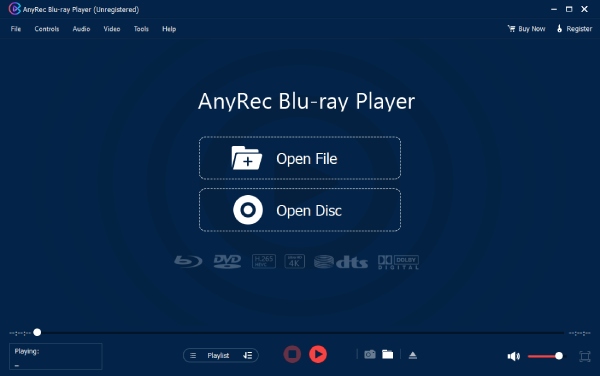
Step 1.Open AnyRec Blu-ray Player. Click the "Open File" button to add your MOV files.
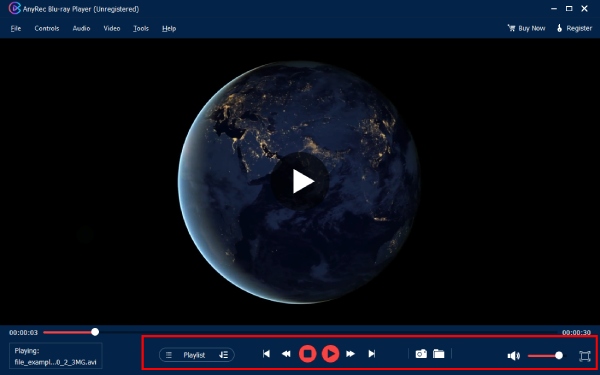
Step 2.Your MOV video will start playing immediately. Adjust the playback speed and volume with the bottom options if necessary.
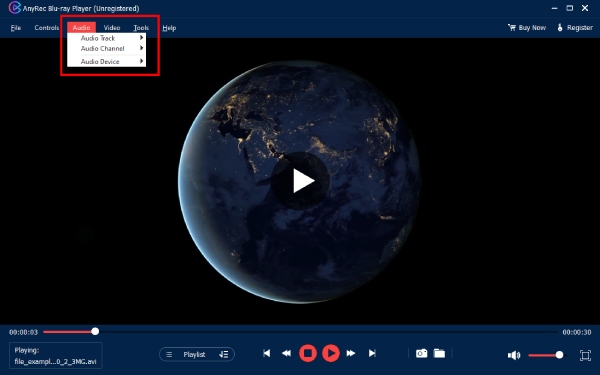
Step 3.Moreover, you can change your audio track, audio channel, and more from the "Audio" and "Video" top dropdown menus.
How to Play MOV Files on Mac
MOV is Apple's own format, so Mac handles it better than Windows does most of the time. But "better" isn't "always". QuickTime still trips up on certain codec combinations, and people report new problems appearing right after a macOS update, such as a file that played fine last week suddenly not opening.
QuickTime Player
Best for: Mac users can play MOV files without installing anything.
MOV is Apple's own video container. Therefore, QuickTime handles MOV files well. You usually don't need to download anything. In most cases, you can open and play camera footage, screen recordings, and standard H.264 or HEVC clips directly.
Step 1.Find the MOV video you want to watch.
Step 2.Double click on it. Choose "QuickTime Player" from the "Open With" right-click menu.
Step 3.Use the controls at the bottom of the window to play, pause, rewind, or fast-forward this MOV video.
Step 4.If the MOV playback still has problems, you can inspect this file with QuickTime's Movie Inspector.

QuickTime is not guaranteed to play every MOV file. Apple says older or specialized formats may require different software. If the file is damaged or uses an unsupported format, you may need other QuickTime Player alternatives.
VLC Media Player
Best for: Users whose MOV file does not work properly in QuickTime Player.
VLC is a popular alternative when QuickTime cannot handle a particular video. The current Mac version supports both Intel-based Macs and Apple Silicon Macs, and VideoLAN provides a Universal Binary as well. VLC is your go-to fallback when you cannot open a MOV file in QuickTime Player.
Step 1.Download and install the Mac version of VLC.
Step 2.Open VLC. Click the "Open File" button from the "File" dropdown list. Browse and import your MOV video.
Step 3.Start the playback and check whether both the video and audio work correctly.

Why Won't My MOV File Play
A MOV file can fail to play for several reasons. The extension itself is rarely the whole problem. The codecs inside the file matter more. For example, an iPhone MOV may use HEVC/H.265, while another MOV uses H.264 or ProRes. Your player may support one but not another. Here are possible reasons.
- Unsupported codec: The video may show a black screen, while the audio still plays. This is common with HEVC files on Windows.
- Missing audio codec: If you can see the video but hear nothing, the audio track may use a codec your player cannot decode.
- Corrupted MOV: If the file fails on every player and device, it may be damaged. This can happen after an interrupted transfer or recording.
- High-bitrate or ProRes video: Large 4K, 8K, or ProRes files can stutter on less powerful computers. Storage speed and hardware decoding can also affect playback.
- Outdated player: An older media player may not properly support newer codecs or video formats. Updating it is worth trying before converting the file.
What to Do If a MOV File Won't Play
Start with another media player. If AnyRec Blu-ray Player or VLC opens the file, the MOV itself is probably fine.
Next, check the codec and update your player. If the file needs to work across several devices or editing programs, convert MOV to MP4, preferably H.264 with AAC audio.
If the MOV file plays in one place but not another, you can convert MOV to MP4 to fix the playback issues.
Conclusion
MOV playback problems can have different causes. An unsupported codec, missing audio, damaged file, or demanding ProRes video can all cause trouble. Try a compatible player to open MOV files on Windows and Mac before converting anything. If you regularly play MOV, HEVC, or high-quality videos, AnyRec Blu-ray Player is worth trying. It supports MOV and HEVC, as well as 4K and HDR playback on Windows and Mac. You can also use it for Blu-ray discs, DVDs, and ISO files without switching to another player.
Secure Download
Secure Download
Related Articles
About Our Author